
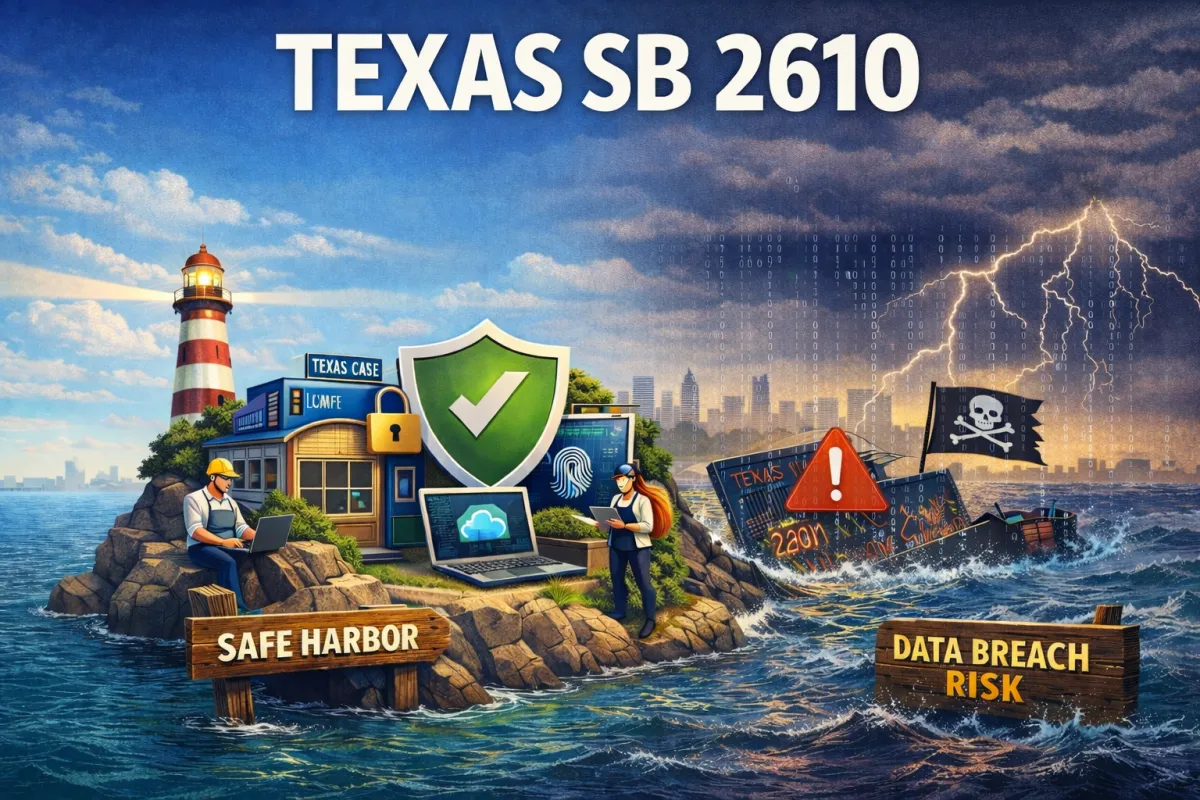
Texas SB 2610: What Texas Businesses Need to Know
Cyberattacks are becoming more common and more expensive for businesses of all sizes. To help small and mid-sized companies reduce the financial fallout of a data breach, Texas passed SB 2610, a new law that rewards businesses for taking cybersecurity seriously. Instead of punishing companies after a breach, this law offers legal protection to those who can show they had the right safeguards in place.
In simple terms, Texas SB 2610 creates a “safe harbor” for qualifying Texas businesses that invest in cybersecurity before something goes wrong. Understanding how it works and how to qualify can make a big difference for your organization.
What Is Texas SB 2610?
Texas SB 2610, which went into effect on September 1, 2025, is designed to protect small and mid-sized Texas businesses after a data breach. The law limits a company’s exposure to exemplary (punitive) damages if the business had a recognized cybersecurity program in place at the time of the incident.
This is important because punitive damages are often the most financially devastating part of a data breach lawsuit. While the law does not eliminate all legal risk, it can significantly reduce the worst-case scenario for businesses that do their due diligence.
Who Does Texas SB 2610 Apply To?
Texas SB 2610 is focused on small and mid-sized businesses, not large enterprises. To qualify, a business must:
Be located in Texas
Have fewer than 250 employees
Own or license computerized data that includes sensitive personal information
This makes the law especially relevant for industries like healthcare, professional services, financial services, manufacturing, and any organization that stores customer or employee data electronically.
Why Texas SB 2610 Is Important For Businesses
For many businesses, cybersecurity feels overwhelming or expensive until a breach happens. Texas SB 2610 changes that mindset by offering a strong incentive to act before an incident occurs.
Here’s why this law matters:
1. It Rewards Proactive Cybersecurity
Instead of adding new fines or penalties, Texas SB 2610 takes a “carrot, not stick” approach. Businesses that implement and maintain a cybersecurity program are rewarded with legal protection when a breach happens.
2. It Reduces Financial Risk
Data breaches are costly. Even small incidents can lead to lawsuits, downtime, and reputational damage. By limiting exposure to punitive damages, Texas SB 2610 helps businesses protect their financial future.
3. It Encourages Better Security Practices
The law pushes businesses toward recognized cybersecurity frameworks, which improves overall security and reduces the likelihood of a breach in the first place.
What Does A Business Need To Do To Qualify?
Qualifying for the safe harbor under Texas SB 2610 depends on your employee count and whether you have a cybersecurity program that fits your size and risk level.
Business Size Tiers
Fewer than 20 employees: There are simplified requirements that include basic password policies and employee cybersecurity training.
20–99 employees: There are moderate requirements where you must align with CIS Controls Implementation Group 1 (IG1).
100–249 employees: You must follow an industry-recognized cybersecurity framework.
Recognized Frameworks Include:
NIST Cybersecurity Framework (CSF)
NIST 800-53 or 800-171
CIS Controls
ISO/IEC 27000 series
SOC 2
HITRUST CSF
Secure Controls Framework
Most importantly, the program must be implemented and maintained at the time of the breach. Having policies on paper is not enough.
What Happens If You Don't Comply?
Texas SB 2610 does not introduce new fines or penalties for businesses that choose not to participate. However, there is a clear downside.
If you don’t have a qualifying cybersecurity program:
You do not receive safe harbor protection
You may be exposed to punitive damages after a breach
You are still subject to compensatory damages
The Texas Attorney General can still pursue action under other laws
Class action lawsuits are still possible
In short, the risk remains higher without compliance.
How Texas SB 2610 Impacts Day-to-Day IT Operations
For many businesses, this law brings cybersecurity out of the “nice-to-have” category and into everyday operations. It highlights the need for:
Strong identity and access controls
Regular patching and updates
Secure backups and testing
Monitoring and logging
Employee training and awareness
Clear incident response plans
This doesn’t mean turning your business into a Fortune 500 security operation. It means having right-sized, documented security controls that match your organization.
How All in IT Helps Businesses Prepare for Texas SB 2610
At All in IT, we help Texas businesses turn Texas SB 2610 into an opportunity and not a burden. Our approach focuses on safe-harbor readiness, combining real security improvements with the documentation needed to prove compliance.
How We Help:
Tier determination and scoping based on employee count and data types
Gap assessments aligned to CIS, NIST, ISO, or SOC 2.
Implementation of critical controls, including multi-factor authentication, endpoint protection and EDR, patch management, backups and recovery testing, and email security and monitoring.
Policies and training tailored to your business size.
Evidence documentation, including training records and configurations.
Ongoing compliance support, such as quarterly reviews and tabletop exercises.
Our goal is to help you strengthen security while building credible proof that your program was in place and maintained.
Turning Compliance Into Confidence
Texas SB 2610 gives businesses a clear message: investing in cybersecurity pays off. By taking action now, organizations can reduce risk, improve resilience, and gain meaningful legal protection when a breach occurs.
All in IT helps Texas businesses build, document, and maintain cybersecurity programs that support SB 2610 safe harbor protection. Contact All in IT today for practical guidance, real security improvements, and documentation you can rely on.