


Drive Change On and Off the Course
All In IT is hosting the 2026 All In FORE Camp Golf Tournament to support Camp Cedarbrook, Texas. Every registration and donation helps provide meaningful experiences and opportunities for those they serve.
Support the cause by registering to play or by donating. Spots are limited, so secure yours today!
Falcon Point
Whether you golf, sponsor, or donate, your participation changes lives.
Register or Donate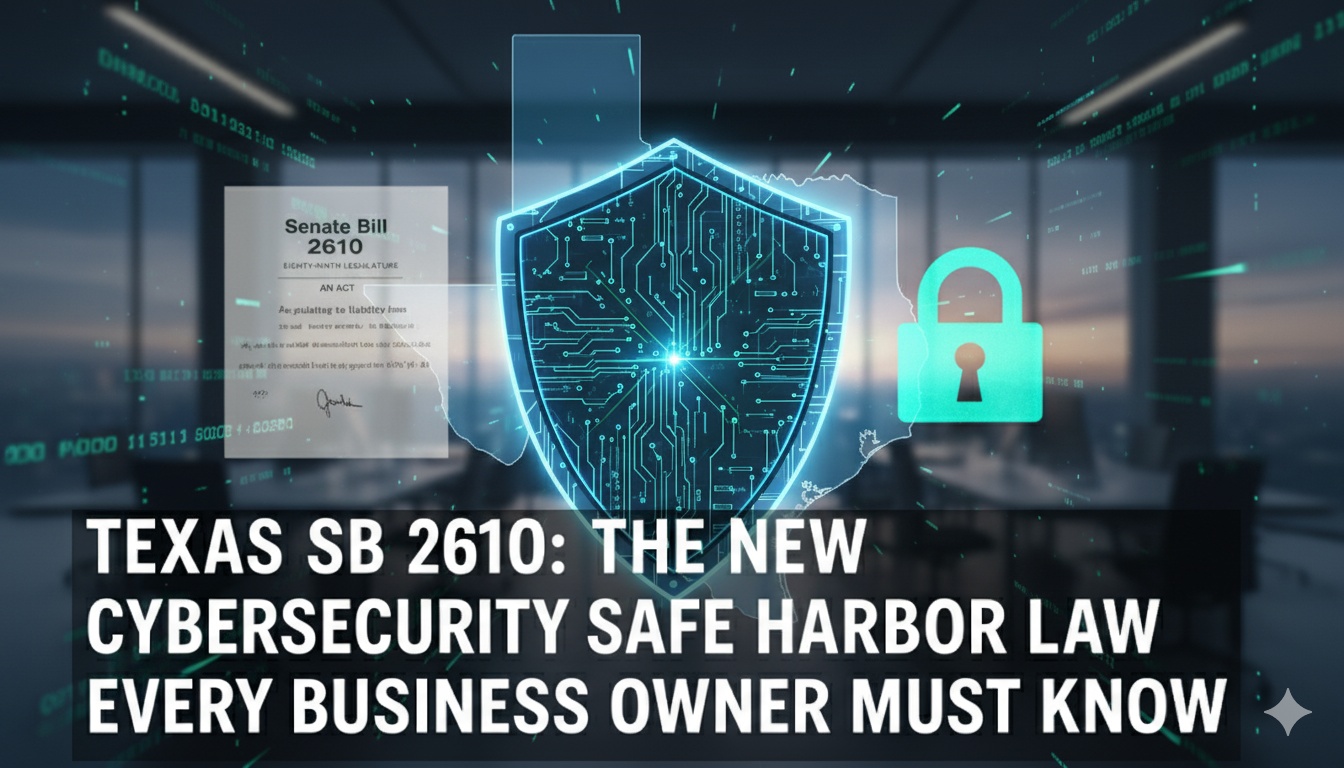
What is Texas SB 2610?
Cyberattacks are no longer just an IT problem; they’re a business risk. That’s why Texas passed Texas SB 2610, a new law designed to help small and mid-sized businesses reduce the legal impact of a data breach.
Instead of creating new fines or penalties, Texas SB 2610 offers something much more valuable: legal protection for businesses that take cybersecurity seriously before an incident happens.
A “Safe Harbor” for Prepared Businesses
Texas SB 2610 creates a cybersecurity safe harbor for qualifying Texas businesses. If your organization experiences a data breach and you had a recognized cybersecurity program in place at the time, the law limits your exposure to exemplary (punitive) damages in a lawsuit. In simple terms:
Businesses that prepare ahead of time are rewarded
Businesses that don’t prepare may face higher legal and financial risk
This approach encourages proactive security without adding new regulatory burdens.
Why This Matters to Your Business
For many businesses, the biggest risk after a data breach isn’t just downtime, it’s the legal and financial fallout.
Texas SB 2610 gives businesses a clear incentive to:
Improve cybersecurity
Reduce uncertainty after a breach
Demonstrate due diligence if something goes wrong
By acting now, organizations can turn cybersecurity from a reactive expense into a proactive risk-management strategy.
Does Your Business Qualify Under Texas SB 2610?
Texas SB 2610 is designed to help small and mid-sized Texas businesses that handle sensitive data, but not every organization qualifies automatically. To qualify, the law looks at business size, data exposure, and whether you have a recognized cybersecurity program in place.
Your business may qualify under Texas SB 2610 if you:
Are a Texas-based business
Have fewer than 250 employees
Own, license, or store sensitive personal information
Use computers, cloud systems, or email to manage that data
If your business handles employee records, customer information, or financial data, this law likely applies to you.
To qualify for safe harbor protection under Texas SB 2610, businesses must implement and maintain a cybersecurity program that matches their size and risk level.
The law recognizes that not all businesses need the same level of security, which is why requirements are scaled by employee count.
Cybersecurity Requirements By Business Size
| < 20 Employees | 20 – 99 Employees | 100 – 249 Employees |
|---|---|---|
| Must meet simplified cybersecurity requirements | Must meet moderate cybersecurity requirements | Must align with industry-recognized cybersecurity frameworks |
| Basic password policies | Alignment with CIS Controls Implementation Group 1 | NIST Cybersecurity framework |
| Employee cybersecurity awareness training | Strong identity and access controls | NIST 800-53 or 800-171 |
| Reasonable safeguards to protect sensitive data | Regular system updates and patching | CIS controls |
| Secure backups and basic monitoring | ISO/IEC 27000 series | |
| SOC 2 or similar standards |
Documentation of Proof Matters
One of the most important parts of Texas SB 2610 is proof. To qualify for safe harbor protection, your cybersecurity program must:
Be implemented, not just planned
Be actively maintained
Be able to demonstrate that it was in place at the time of a breach
In order to show compliance, you will want to gather your policies, training records, system configurations, and security reviews.
Texas SB 2610 does not impose new fines or penalties if you choose not to comply. However, businesses that do not meet the requirements:
Do not receive safe harbor protection when a breach occurs
May be exposed to punitive (exemplary) damages after a breach
Still face compensatory damages and regulatory enforcement
In other words, the risk remains higher without a qualifying cybersecurity program.
How All in IT Helps with Texas SB 2610 Compliance
Texas SB 2610 rewards businesses that prepare before a data breach happens. All in IT helps you do exactly that.
We guide Texas businesses through a clear, practical path to SB 2610 readiness, without unnecessary complexity or enterprise-level overhead.
What We Do
Determine if your business qualifies under Texas SB 2610
Identify your required cybersecurity tier
Assess gaps in your current security program
Implement the controls that matter most
Provide documentation to support safe harbor protection
Maintain your cybersecurity program over time
Our approach is right-sized, framework-aligned, and built for small and mid-sized businesses.
Enhancing Your Business Continuity: Always Be Prepared
Predictable Billing: No More Surprises
At All In IT, we believe in delivering IT solutions that offer you more control, predictability, and peace of mind. Our Private Cloud services are designed to address the common challenges businesses face with public cloud providers like Microsoft Azure and AWS, providing a superior alternative that aligns perfectly with your operational needs and concerns.
One of the key differences in our approach is how we handle billing. Unlike public cloud providers, which operate on a usage-based billing model that fluctuates month to month, we offer a straightforward, predictable billing structure. When you work with us, we assess your exact needs—processor, hard drive space, memory—and you pay for these resources ahead of time. This means no surprises at the end of the month, just a standardized, easy-to-manage bill that allows you to budget with confidence.
Complete Control Over Your Data
Control is another area where our Private Cloud stands out. In Texas, there’s often a hesitation to trust large, government-associated entities like Microsoft with sensitive business data. We get that. With our Private Cloud, you retain complete control over your data. Whether it’s accessing your information quickly in a disaster recovery situation or ensuring your data is stored and managed in a way that aligns with your values, we’ve got you covered.
In a public cloud environment, getting your data out during a disaster can be a costly and time-consuming process. Providers like Microsoft Azure often charge egress fees and can’t provide clear timelines for data retrieval. With All In IT’s Private Cloud, we can give you a precise estimate and even deliver your data physically if needed. Our clients appreciate the faster performance and better pricing they experience when transitioning from Azure to our Private Cloud.
Company
© 2026 All in IT. Built with MSP Sites. Privacy Policy


