
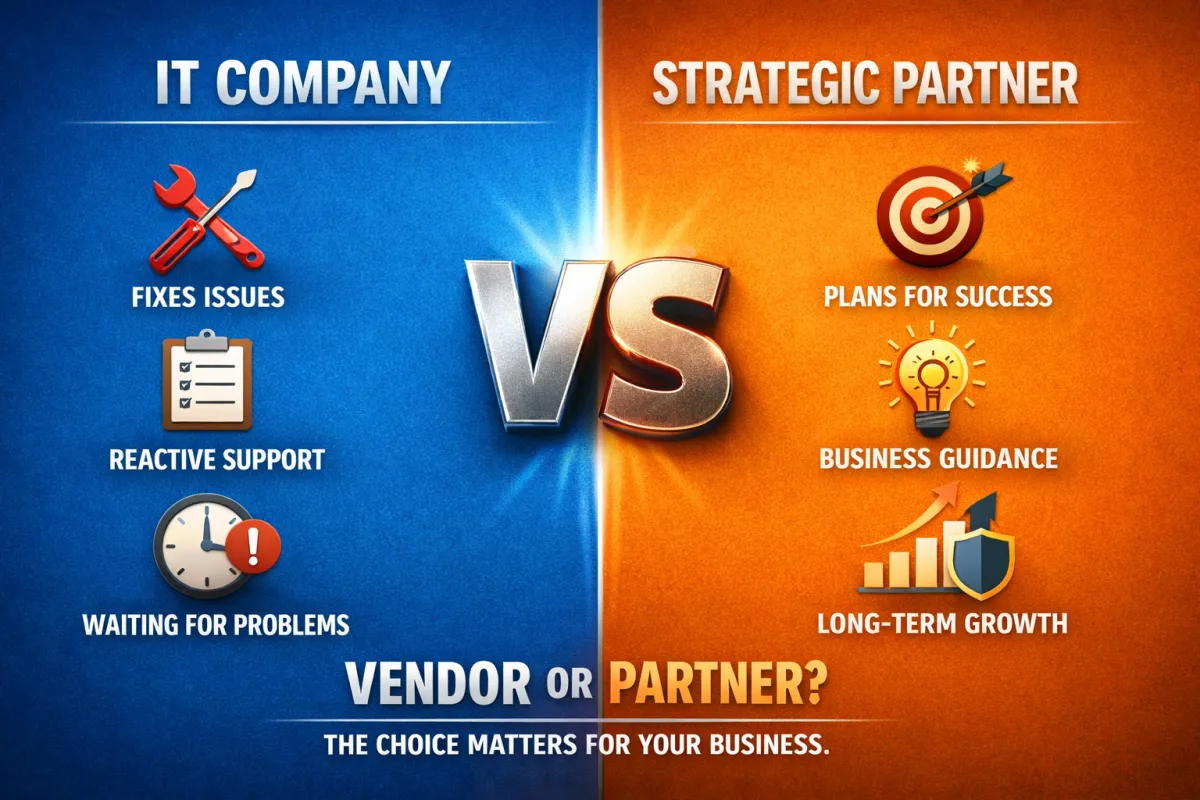
IT Company vs Strategic Partner: What's the Difference?
If you’ve ever felt like your IT provider only shows up when something breaks, you’re not alone. A lot of businesses pay for support, but they don’t get guidance. That’s the real gap between when it comes to an IT company vs strategic partner. One is a vendor that fixes problems. The other is a partner that helps you use technology to run a smarter, safer, faster business.
Let’s break it down in plain English, and I’ll share the questions we ask at All in IT that most “regular IT companies” don’t.
A Traditional IT Company is Reactive. A Strategic Partner is Proactive.
Here’s the simplest way to explain it:
·A traditional IT company is mostly reactive and technical. They fix tickets, keep things running, and quote projects when you ask.
A strategic partner is proactive and aligned with your business. They help you make business decisions with technology by reducing risk, enabling growth, and improving efficiency with a plan, measurable outcomes, and leadership-level conversations.
That’s the heart of the IT company vs strategic partner conversation. An IT vendor waits for your printer to fail. A strategic partner asks, “How do we stop this from happening again, and what else is slowing your team down?”
The Questions Your IT Provider Should Be Asking
When we start with a new client, we don’t begin with cables and software lists. We start with context. Here are some of the first questions we ask, because they shape everything that comes next:
1. "What are your top three goals in the next 12-24 months?"
If your IT provider doesn’t know where your business is going, how can they build technology that supports it? Growth plans matter when it comes to new hires, new locations, new services, and even mergers.
2. "What does downtime look like, and what would that cost you?"
A lot of business owners ask, “What will IT cost?” We ask, “What will downtime cost?” Because two days of downtime can crush a team’s productivity and revenue.
3. "What data would be catastrophic to lose?"
Not all data is equal. Losing payroll data, client files, financial reports, or operational systems can be a real business emergency. We want to protect what truly matters.
4. "Where do you lose the most time and money today?"
We ask about real workflows for sales, operations, billing, and field work because that’s where technology can remove friction.
5. "Who owns the IT budget and security decisions?"
If the decision-makers aren’t involved early, plans stall. We want the right people in the room before we recommend solutions.
This is a big reason the IT company vs strategic partner difference is so noticeable: strategy starts with better questions.
Why Business Goals Matter More Than "More Tech"
I say this a lot: IT is not the goal, it’s the lever. If your IT provider doesn’t understand your business, they might “optimize” the wrong thing.
They might make you “more secure,” but slow down operations.
They might make things “cheaper,” but create downtime risk that costs far more.
They might recommend tools that don’t match how your team actually works.
Strategic IT is about trade-offs like speed vs control, cost vs resilience, convenience vs compliance, and those are business decisions.
That’s why an IT company vs strategic partner isn’t just a service difference. It’s a mindset difference.
The Relationship Just Isn't There
We’ve had clients come to us and say they’re leaving their current provider because the relationship isn’t there. One client told us their provider brought a holiday gift… that the main contact was allergic to. To top it off, they dropped off the gift when they had already been told the office would be closed.
That story isn’t really about food. It’s about attention. Listening and knowing your client.
When it comes to IT service providers, we constantly hear:
“They were good for a couple of weeks, then they fell off.”
“We never felt connected.”
“We don’t have a strategy, we have ticket fixing.”
This is another part of the IT company vs strategic partner reality: partners don’t disappear after onboarding.
How All in IT Becomes A Partner (not just a provider)
So, what do we actually do differently?
Step 1: We set the baseline and stabilize the fundamentals
Before we talk about big changes, we make sure the basics are solid:
Multi-factor authentication (MFA) everywhere
Backups in place
Patching done properly
Endpoint protection
Admin controls handled the right way
Step 2: We prioritize based on timeframes and impact
We don’t come in and say, “Buy all new computers right now.” Instead, we map priorities into timeframes with what to do in the next 60–90 days, next 6 months, and next year.
Step 3: We match the plan to budget reality
We often present “good / better / best” options, so leadership can choose what fits. Sometimes that includes creative ways to save money, like certified refurbished hardware with a warranty that can cost significantly less than brand new. That’s partnership: protecting the business while respecting the budget.
This is what we mean when we say IT company vs strategic partner. We’re not just selling tools. We’re helping you make smart choices.
Ongoing Conversations You Should Be Having (but probably aren't)
A strategic partner doesn’t just “support.” They communicate. There should be a regular business review process held monthly or quarterly, depending on the business, so both sides can talk about changes, upcoming needs, and what’s happening in technology.
Some examples of what those conversations include:
Security posture and alerts (like unusual logins or travel-based access)
Lifecycle planning (refreshing equipment before it dies)
Process improvement (removing friction in scheduling, field work, billing, operations)
Vendor management (helping coordinate with internet providers and software vendors)
That’s how you stay ahead instead of falling behind.
Red Flags: Sign You Have a Vendor, Not a Partner
If you’re wondering whether your current provider is more “IT company” than “strategic partner,” look for these red flags:
No roadmap (everything is “as needed” and reactive)
No leadership-level meetings (only ticket conversations)
Vague answers on backups, MFA, admin access, logging
No reporting offered
Surprise bills and unpredictable project charges
They don’t talk about helping you grow, manage risk, or handle compliance
Here’s my favorite way to say it: “If they only show up when something breaks, you don’t have a partner, you have a repair shop.” That line sums up the entire IT company vs strategic partner difference.
Ready For an IT Partner, Not Just IT Support?
If you want an IT team that understands your goals, helps you plan ahead, and protects your business without surprise bills or constant fire drills, let’s talk.
Contact All in IT to schedule a discovery conversation. We’ll ask the right questions, find the real risks, and build a clear plan that fits your business.
Matt Daniel, CEO & Founder
Matt Daniel is the founder and CEO of All in IT, where he helps skilled trade businesses build secure, reliable, and scalable technology systems. With years of hands-on experience supporting contractors, HVAC companies, and other field service professionals, Matt is passionate about making IT simple, practical, and profitable for the trades.